In late 1965, the Rev. Dr. John Coleman Bennett, President of Union Theological Seminary, convened a group of faith leaders to voice a growing concern about the war in Vietnam among religious leaders. Together, they formed Clergy and Laity Concerned About Vietnam (CALC) which consisted of a number of prominent ministers, but none more prominent than Rev. Dr. Martin Luther King Jr., who represented the movement that had just secured the passage of the Voting Rights Act that same year. For two years, as the death toll climbed, King wrestled with the choice to speak out against the war.
When he finally decided to break his relative silence, he asked his longtime speechwriter, Clarence B. Jones, to draft a speech that could explain his opposition. As the political scientist Saladin Ambar recounts, Jones — seeking to protect King from the inevitable fallout — delivered a draft that was far too "tame." King was furious: "Don't you know I have a responsibility as a minister?" he exclaimed. He took the draft instead to Vincent Harding, who helped him turn it into the indelible words of "Beyond Vietnam."
On April 4, 1967, at Riverside Church, King declared his opposition to the war in unflinching terms, famously linking the "giant triplets" of racism, extreme materialism, and militarism. The backlash was immediate and vicious. President Lyndon Johnson was furious; *The New York Times* was blistering; even the NAACP criticized the speech as a strategic failure. One year to the day after delivering that speech, an assassin's bullet took King's life.
Now, 61 years after the formation of CALC, the need for a "concerned clergy and laity" has never been more urgent. We see the same patterns today: the U.S. is once again at war abroad — our actions in the world contribute to starvation, prop up brutal dictators, sanction extrajudicial killings, and threaten and condone genocide, while at home, masked agents brutalize noncitizens and citizens alike on American streets. We rightly battle over the mechanics of November elections, but our current crisis is not the result of a single election cycle. It is the unfinished work of the 1960s — the reckoning that was deferred when America gunned down the leaders who called for a "revolution of values."
King was warned that alienating the administration would be costly. His response in the speech reverberates today: "I have fought too long and hard to end segregated public accommodations to segregate my own moral concerns. Justice is indivisible."
I am among today's concerned clergy. The bigotry unleashed over the last decade reveals the depth of our democratic decay. There is a crisis of conscience in this country. There are many reasons why we got here: racism, greed, the commodification of the common good. The fact that Pope Leo has felt compelled to clarify the Church's teachings on war in an open rebuke to this administration is remarkable. As Pope Francis attempted to do, he also felt the need to right-size the role of human sexuality in Catholic moral teaching as he condemned this latest unjust war. After decades of American bishops of the Roman Catholic Church joining Evangelicals in their relentless focus on human sexuality and reproduction as if it was the central theme of the Gospels, this felt indeed necessary.
Abortion and LGBTQ+ inclusion have been used as the perennial wedge issue, fueling our belonging into ideological camps. My experience as a gay man is one in which Christian leaders often ignored our humanity in pursuit of a spiritual war. The result was a "hardening of hearts" that gave way to a moral vacuum and an absence of conscience. I can't help but feel that the same theological rigidity that allows families to discard their queer or trans children is the same hardening that allows a nation to condone the caging of children, the brutalization of strangers, and the killing of Renée Good and Alex Pretti. By consuming itself with battles over human sexuality, much of the American church forfeited its role in shaping the nation's morality.
Vincent Harding, whom I had the honor of accompanying in his final years, often reminded us that the Southern Christian Leadership Council (SCLC) had a motto to "save the soul of America." We are in a moment of profound spiritual crisis. Not all churches supported the black freedom struggle. Not all churches condemned the war in Vietnam. Some did, and this is a moment when Christians — and all of us — get to ask ourselves with whom they wish to stand.
Of course, this call to conscience is not exclusive to Christianity. There's often been a collection of us on the margins of our tradition. I am particularly grateful for the Buddhist teachers like Rev. angel Kyodo williams, Pamela Ayo Yetunde, and Rima Vesely-Flad who have provided healing for many whom my own tradition nearly destroyed. I am grateful for the Jewish leaders who have been powerful voices of dissent against a country committing crimes against humanity in the name of the Jewish people. I pray for Muslim leaders the world over, to whom we have assigned this impossible task of holding the justified grief, heartache, and anger of their faithful as bombs are dropped on children and civilizations threatened with annihilation, while pulling them back from the cheap comfort of nihilist rage and extremist lies.
At a time when some of the most visible representations of American Christianity champion imperialism and violence against the vulnerable, I feel the need to represent what Howard Thurman called "the moral insights of the faith I proclaim."
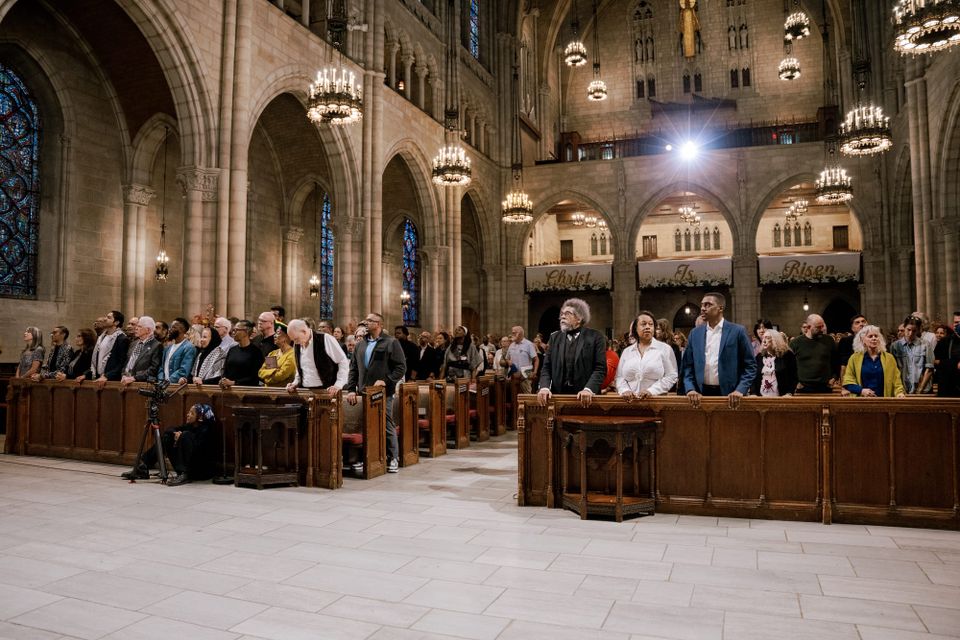
On April 4 of this year at Riverside Church, I partnered with Union Theological Seminary and the National Council of Elders to convene a gathering to honor the spirit of Clergy and Laity Concerned and to re-voice the famous words that Martin Luther King Jr. and Vincent Harding wrote in 1967. As we listened to the words voiced by people whose lives and work represent some of the most pressing moral and ethical issues of our time, we all felt how so many of those words are still so hauntingly true. So then, the work must continue.
The work continued after '67; through assassinations and repression, it went on. For the remainder of 2026, in collaboration with Union Theological Seminary's National Storytelling Initiative on Christian Faith and Life, I'm traveling to congregations throughout the U.S. using the legendary Student Nonviolent Coordinating Committee worker John O'Neal's Story Circles to draw out both our shared history and hopes for democracy in this country and to (re)connect us to each other. This is my contribution to this moment. I'm joining a growing number of us — clergy, laity, and other people of conscience — "concerned" and working to save the beleaguered soul of the nation.
Subscribe to the newsletter
Join me in conversation as I reflect on love, hope, healing, and the work of building the beloved community in disorienting times.

Member discussion